I have been talking to many working professionals over past few weeks about their need to work and what they seek from work. This post (and the next one) summarizes my observations and theory around what I hear.
From a career and motivation perspective, there are 4 levels of employees in an organization:

- Entry Level employees (Level 1): These are employees who are still figuring out how their career will proceed. Typically these are employees with 0-5 yrs of experience. They need a secure job that can fulfill their basic needs and they are willing to be very flexible around what roles they take up to achieve this. They are mostly unclear of their career goals and rely on their manager for all career guidance.
- Senior Employees, Frontline managers (Level 2): These are early stage careers. Typically, these are employees with up to 5-10 yrs. of experience and they want to become experts in their domain, while achieving financial security for themselves. They have achieved basic needs from the job and are now looking to cement their place at workplace by developing expertise and steering their career in a certain direction.
- Middle Managers (Level 3): These are mid-stage careers. Typically these are employees with 10-20 years of experience. They have achieved financial security and seek fulfillment and satisfaction from their work. They work with the executives to interpret company vision into execution steps that IC and frontline managers work on. They understand that they need to manage their own career and very rarely rely on their manager to guide them in this respect.
- Executives (Level 4): These are late-stage careers. This is a very small set of employees who set company’s vision and direction, and are responsible for leveraging middle managers.
The motivations and behavior exhibited by these employees closely reflect the hierarchy of needs:
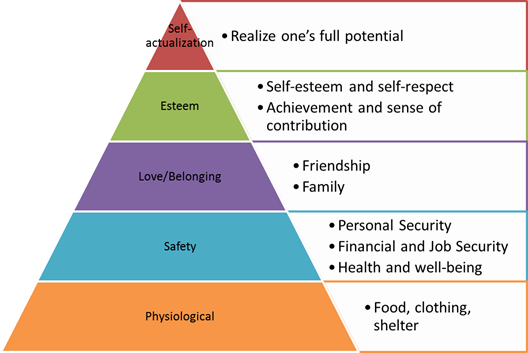
Adapted from Wikipedia article
If you compare the 5 levels in the hierarchy of needs with 4 levels in the career hierarchy, here are some of the inferences that can be drawn:
- Level 1 employees seek to fulfill the bottom 2 levels of needs hierarchy (physiological, safety). Hence they are driven more by extrinsic motivators like salaries, promotions etc.
- Level 2 employees seek to fulfill next level of love/belonging, their physiological needs are met by the time they move into Level 2. Safety and Love/Belonging needs drive them to focus on extrinsic motivators but they also seek (non-financial) recognition, networking with others, and focus on future safety needs (and hence the desire to manage the career more proactively and by themselves).
- Level 3 employees move to the next level of Esteem where they seek a sense of contribution, self-respect and self-value, which they can get by taking up influential positions in their organizations (which may not be possible all the time) or in their social network (alma mater, society, part-time jobs, etc.). Their safety needs are fully met, they have gained expertise in their domain and they are significant assets to their organization, though it is doubtful how much of their capabilities are being leveraged in their current organization.
Merging career hierarchy and needs hierarchy gives some interesting perspectives for career management in an organization and for individuals. Based on my experience in working and talking with hundreds of working professionals over past several years, I see this in play in very large number of cases. Here are two ways this can be used:
- Practicing managers: This is a good model to keep in mind when you evaluate your reports; you can try to see which needs they are trying to fulfill.
- Self Career Management: This is a good way to identify your own motivations (which are not clear sometimes) and also in making sure that these needs are being met. Sometimes, when the needs are not being met, you can become anxious and tense, and not realize why this is happening.
Of course, this is over-simplification, two caveats come to mind:
- Hierarchy of needs says that it is not strictly heirarchial and same person can operate at different levels. So saying Level 1 employee operates at bottom 2 levels is not entirely correct, they may be operating on higher levels as far as some other needs are concerned (say creativity, which is the highest level of this hierarchy).
- # of years of work is a practical but sometimes useless measure of experience, since it depends so much on what kind of organization and what kind of roles the individual has been engaged in. These numbers shouldn’t be taken literally.


 Career Bloom
Leave a comment