Career Bloom

Your source for authentic and practical career advice

  • I have had the opportunity to talk to many college going students and fresh college passouts about their goals, and most of the time I hear them talking about ‘getting a job with highest possible salary’. Everytime I end up telling them to look for jobs with learning and growth potential instead, and most of the time I get the look of ‘what about money then?’. It takes some explaining, but I guess I am able to get through the point that I may be right. They still have gone ahead and ignored my advice, but I guess that is what free advice deserves!

    I strongly believe that focusing on learning and growth potential at the start of the career is very important, money is probably the least important parameter. Here is a typical picture that I draw to illustrate my point. Note that the axis has salary, because that is the most measurable aspect of career development still.
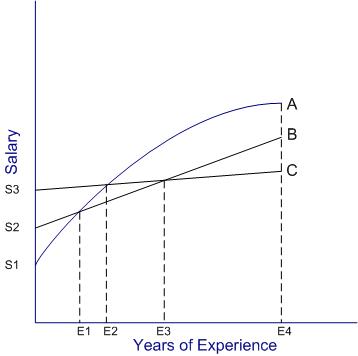
    Salary variation over the years

    (more…)

  • Recently I bumped onto this post from Sanjoy about a career management cum social networking company idea. It is a “career management application that combines social networking, resume management and ongoing skill development”. It is interesting because it looks at this industry from the consumer’s perspective, the individual who is looking for a job. Similar thoughts has led to creation of JibberJobber. Here is how one blog describes it:  “JibberJobber is a set of tools that anyone with an interest in managing their own career should embrace.

    Of course, there are the business networking tools like LinkedIn which are evolving to be more helpful to job seekers even though they cater to general business networking area (how good your network can be if it can’t get you a good job?).

    However, there aren’t really good tools out there which can help a job-seeker: what they need is on the lines of resume/job management system! Anyone interested in building one, or knows something existing?

  • If you are exposed to US schools and colleges, you will realize that resident counselors are available in almost all the schools, armed with on-line and offline personality test suites, and willing to provide career guidance for colleges as well as jobs. Private career counseling services abound too.

    Contrast this with situation in India: very few schools actually have counselors available, and while private career counseling is available, it is not as abundant, and their effectiveness is questionable too. It is very clear that this industry segment hasn’t really taken off in India the way it has in US.

    Why is that? Here is my explanation of this.

    US education system is all about choices, choices in studies, choices in job options, choices in colleges, etc. Students take all kinds of courses through the school and decide only in the last minute what do they want to pick in college. Once in college, again they take as many kinds of courses they like or they can since rules for getting a major in a particular subject is very flexible. Hence, when the time comes to pick one, it becomes a huge problem and career counseling services become almost necessary to make some sense out of so many options available.

    (more…)

  • Talent Management is the new buzzword in US companies which are facing shortage of talent: aging population, talent scarcity at top, need to grow internal talent, all contribute to this need. This newly defined industry has 4 components: recruitment management system, learning management system, performance management system, and compensation management system, read this link for more details of this industry: http://www.talentmanagement101.com/.

    Natural question comes up: Is this same as Individual career management? In my opinion, answer is no. The reason is that while consumer in an employee talent management industry is a corporation which wishes to track and aggregate talent profiles of employees to solve some talent needs, in case of individual career management, however, it is the individual, and there is no aggregation involved. This means that workflows and use cases (that rely on aggregation) will be very different in these two industries, even though they may start off same skills inventory. This is not to say that they are not similar, and there will be some synergy between these two, but only when both of these are matured. For example, an important question answered by Employee Talent Management softwares is: how to manage and plan succession. This requires access to skills inventory of relevant employees. Aggregation and analysis of entire skills data is an important part of such a feature. However, this doesn’t belong to individual career management industry, where an important question might be: how can I succeed in getting a job that is aligned with the jobs I have been taking so far and strengths I have been displaying.

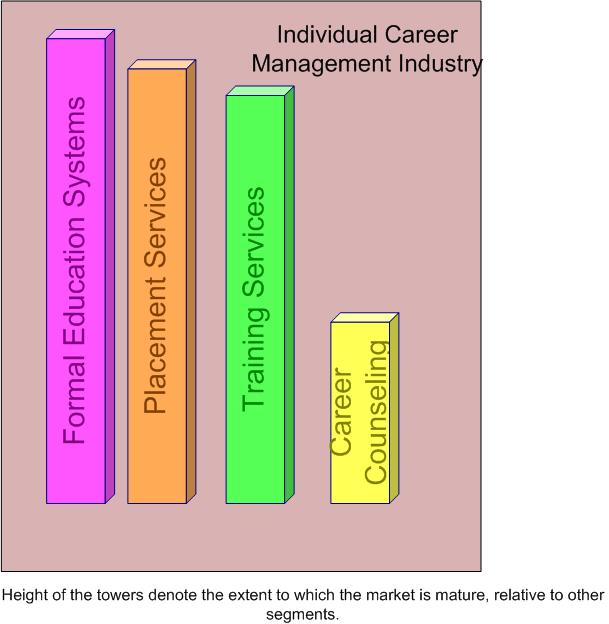
  • Individual Career Management

    This is a first-cut description of what such an industry looks like. The height denotes relative maturity of the market in India, even though most of these markets are fairly fragmented.

    (more…)

  • This blog will attempt to capture my thoughts, views, and readings on defining a new industry for India which focuses on Career management and talent optimization for Individuals. I will call this “Managing Individual Talent (MInT)” industry,  I define MInT (to be efficient, I will call it Mint hereafter) as a new and evolving industry in India which is concerned with the entire lifecycle of an individual as he/she grows moves from Class X to job retirement, and everything in between that relates to the career, education, and optimizing talent. This is a superset of various industries like career counseling, various types of training and placement services, job portals, etc. Mint is becoming more important because of huge gap between supply and demand of capable engineers in IT sector and other growing parts of India economy. This gap can be traced to many reasons:

    (more…)